Last updated August 2026
Everyone says winter, and everyone is half right
Ask around Nelson about pruning your apple or plum tree and you will be told to do it in winter. It is the standard answer, it is in every gardening column, and it is not wrong.
★View the Best Tree Trimming in Nelson→It is just incomplete. Winter is the default, not the whole answer, and treating it as the only window is why a lot of home fruit trees end up too tall to pick from, full of vertical whippy growth, and producing less each year despite being pruned religiously every July.
Here is what each season is actually good for, and why the timing changes depending on what kind of tree you have.
Why winter became the default
There is a practical reason winter pruning caught on: you can see what you are doing. With the leaves off, the framework of the tree is fully visible. Every branch, every crossing limb, every bit of congestion in the middle is right there, and the work goes faster and more accurately than it does through a canopy of foliage.
For structural work (deciding the shape of a young tree, taking out a major limb, opening up a crowded centre) that visibility is genuinely valuable. Winter is the right call for that job.
What winter pruning does to the tree
The part people miss is what the cut causes. A deciduous fruit tree in winter is dormant with a full root system’s worth of stored energy waiting to go somewhere. Prune hard then, and come spring that energy is redirected into whatever growth points are left.
The result is vigour: strong, upright, fast-growing shoots (water shoots) often exactly where you do not want them, and usually straight up. Which is why a tree that gets a hard winter prune every year can end up taller and denser than one left alone, and why some people feel like they are fighting their tree.
That response is useful when you want growth: a young tree you are still building, or an old one you are renovating. It works against you on a mature tree that is already the size you want.
Summer pruning after harvest
Pruning in summer, once the fruit is off, does close to the opposite. The tree has already spent its energy on the crop, the growth surge is over, and cuts made then tend to calm the tree down rather than provoke it. It is the tool for controlling size and keeping a tree at a height you can actually harvest from.
Cuts also heal faster in warm, dry weather, and that is not a minor point. See the next section.
The New Zealand Tree Crops Association sets out the case for summer pruning of stone fruit in detail, and it is worth a read if you would rather understand the reasoning than take anyone’s word for it.
The silverleaf reason, which is the important one
If you grow plums, cherries, peaches, nectarines or apricots (anything in the Prunus family) timing is not just about vigour. It is about disease.
Silverleaf is a fungal disease caused by Chondrostereum purpureum. It spreads by airborne spores that land on freshly cut, exposed sapwood, and it is progressive and frequently fatal to the tree. There is no chemical cure; prevention is the whole strategy. Kiwicare’s guidance covers identification and management.
The spores are released mostly in cool, wet conditions. Which means the standard advice for stone fruit in New Zealand is the opposite of the winter default: prune in summer or early autumn, in warm dry weather, lightly, straight after harvest. Avoid pruning stone fruit in the wet altogether.
So “prune in winter” is decent advice for apples and pears and genuinely risky advice for plums and cherries. That distinction is the single most useful thing on this page.
Spring has a use too
Spring pruning gets less attention but has one real advantage: you can see where the fruiting wood and the new branching are coming from. That makes it easier to make precise cuts, keeping the wood that will actually carry fruit and removing the wood that will not, rather than guessing at a bare framework in July.
For most home growers the sensible pattern on an apple or pear ends up being structural work over winter or into spring, then a tidy-up after harvest to hold the height. Stone fruit stays in the dry-weather window.
Hedges and ornamentals run on a different clock
None of the above transfers to your hedge. Buxus, griselinia and the like are trimmed on appearance and growth rate, usually a couple of times through the growing season, and the considerations are shape and density rather than fruiting wood.
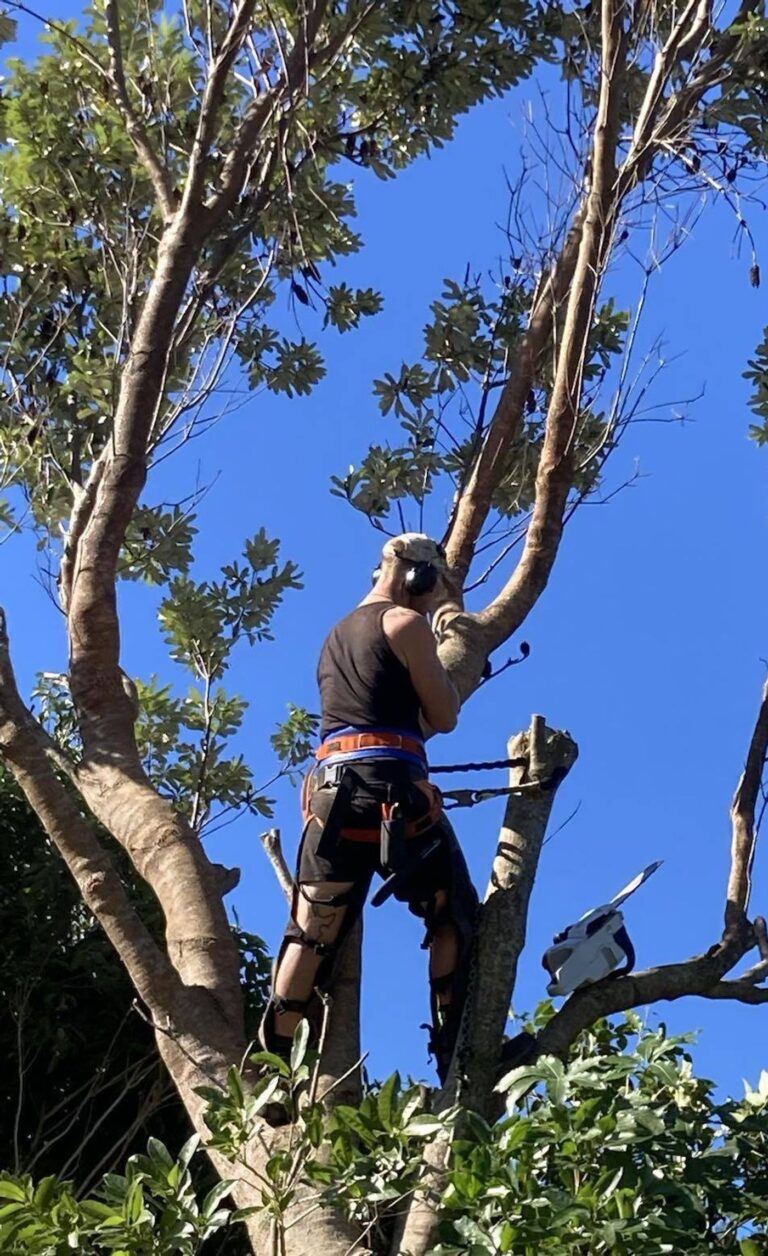
Large ornamental trees are different again. Removing limbs for light, for a view, or for a neighbour is a job about weight, balance and where the tree will put its energy next, and once it involves climbing or working over a fence, a roof or a driveway, it stops being a ladder-and-loppers job. The Nelson region also has rules on protected trees, so it is worth checking before any significant work on a mature specimen.
Then there is the waste. A morning’s pruning generates a surprising volume of material, and getting rid of it is often the part people underestimate. Chipping it on site and putting it straight back on the garden as mulch is the tidiest outcome.
Where Tasman Treehugger fits
Tasman Treehugger is Nathan Davis, working across Nelson, Richmond, Wakefield and Motueka with over twenty years in trees and horticulture.
Fruit trees are his specialty: shaping a tree to carry its crop at a height you can actually reach. He takes the timing question seriously rather than defaulting to winter for everything. He also handles ornamental tree pruning and hedge trimming, from a buxus hedge through to climbing a large gum to reduce limbs.
Waste goes out by caged trailer or through his chipper to come back as mulch on your garden. Quotes are free and priced case by case after he has seen the job, so get in touch to arrange a look.